Service Cuts Alone Won't Solve RTD's Structural Deficit.

The recent discussion around reducing RTD service is a difficult but necessary conversation. With the agency facing a structural budget deficit of more than $200 million, it is clear that spending cannot continue to outpace revenue indefinitely. Responsible financial stewardship requires making hard choices. However, service reductions should be viewed as a short-term tool—not a long-term strategy. I am confident that none of the current 15 RTD Board members wants to reduce service. These are difficult decisions driven by financial realities, not a lack of commitment to riders.
Every trip that is eliminated represents someone who may no longer be able to get to work, school, a doctor's appointment, or home without a car. Cutting service can also reduce ridership, creating a cycle where fewer riders lead to less revenue and even greater pressure for future cuts.
RTD must do more than simply shrink its way to financial stability. We need a long-term vision that grows ridership while controlling costs. As an architect specializing in housing and transit-oriented development, I believe one of RTD's greatest untapped assets is the land it already owns. Hundreds of acres of underutilized Park-n-Ride lots represent an opportunity to build housing, retail, offices, and community spaces directly adjacent to transit. These developments can create long-term revenue for RTD while placing thousands of new residents and workers within walking distance of high-quality transit. Had RTD pursued this strategy more aggressively over the past decade, the agency would likely be in a much stronger financial position today.
At the same time, RTD should continue improving operational efficiency, invest in the routes that carry the most riders, and focus on delivering reliable service that people can depend on every day.
The current financial challenges also reinforce the importance of the Comprehensive Operations Analysis now underway. This process provides an opportunity to redesign the network around today's travel patterns and ensure every service dollar delivers the greatest possible value to riders and taxpayers.
I support responsible budgeting, but I don't believe balancing the books should come at the expense of RTD's future. We need leadership that can make difficult financial decisions while also building a stronger, more sustainable transit system for the next generation.
Reliable transit moves us forward—but only if we have the vision to invest in its future.
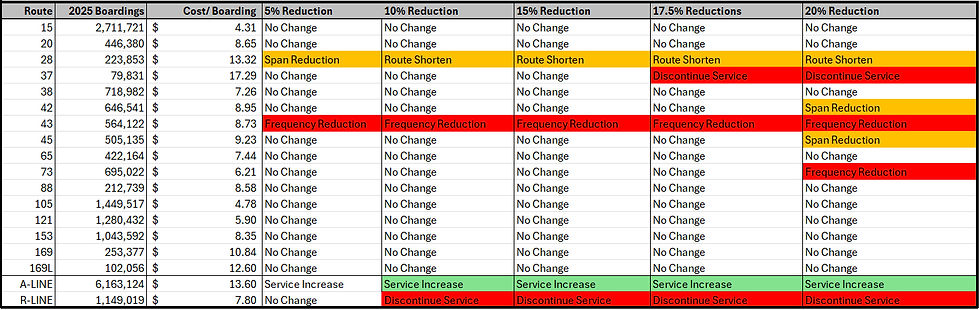
As these proposals are still in the early stages, I also want to highlight what they could mean for riders in District B. Based on the preliminary information available, the R Line would be eliminated. At this point, it is unclear how that service would be replaced, if at all. Maintaining reliable rail service along that corridor is essential, and abandoning it without an effective alternative is not an acceptable outcome.
Affects on District B:
The proposal also affects Route 43, which serves Northeast Park Hill via Martin Luther King Jr. Boulevard. I am continuing to review the details to better understand how these proposed reductions would impact the community. As more information becomes available, I will keep riders informed and advocate for solutions that preserve reliable transit service for District B. (see spreadsheet below)

Comments